This photograph taken by Ansel Adams is of a cactus out in
the west. The cactus is often seen as symbolic of the great American West and
the desolate plains that dominate the land. The camera angle is no mistake
here, Ansel wants the viewers to see the dark, grey clouds that swell overhead
and he wants the viewers to grasp how thick and bold the cactus is. For all
these things represent what the American west is; Wild and strong, dark and
ultimately a mystery. The cactus may even represent a metaphorical/literal
thorn in America ’s
quest to strive and expand to its fullest potential.
Monday, 9 February 2015
Sunday, 8 February 2015
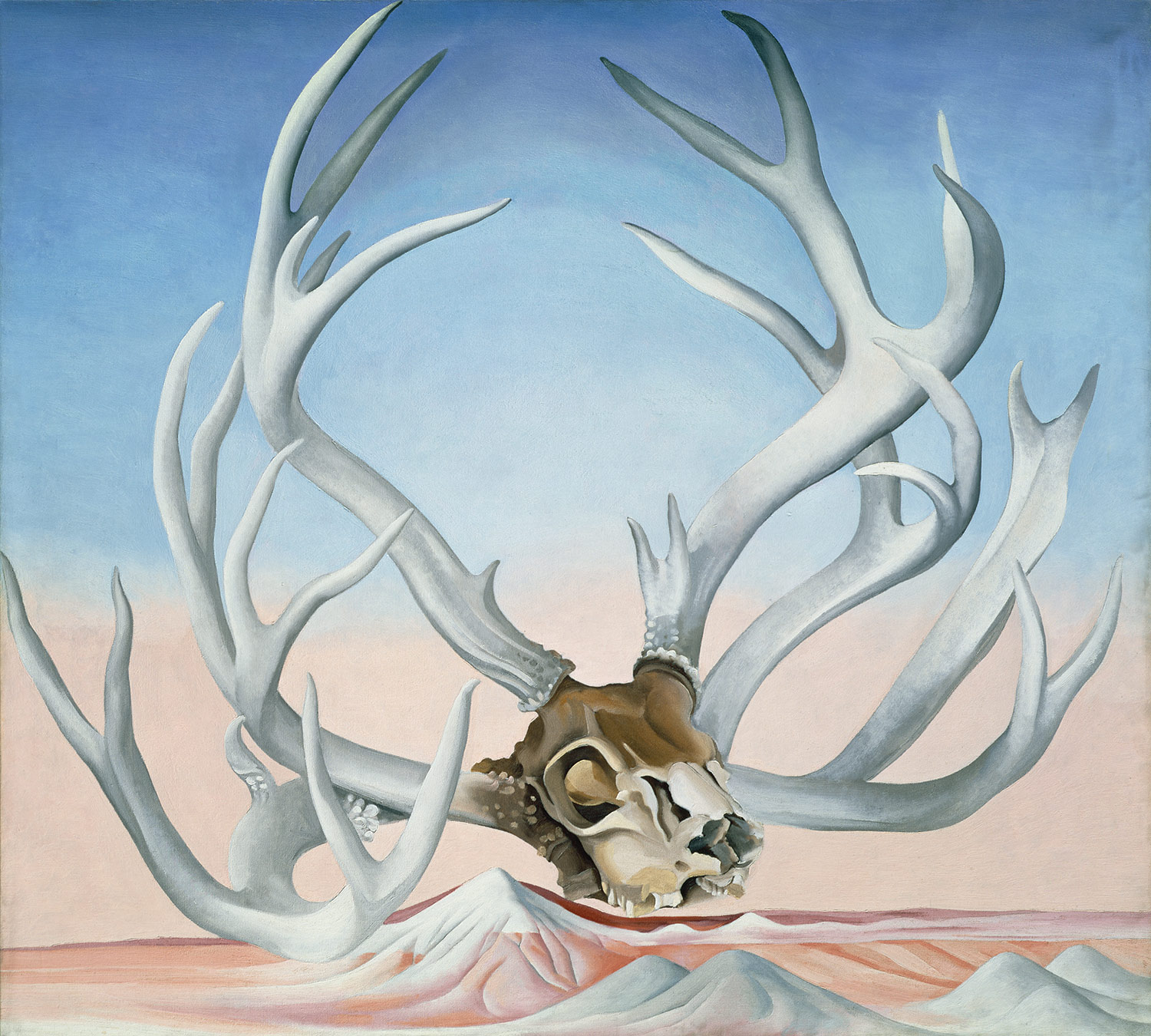
From the Faraway Nearby
The painting depicts a deers head floating over the Arizona desert,
and is by Georgia O’Keeffe an American modernist painter born in 1887 who is know for her large format paintings of flowers. It is one of a series of similar paintings featuring animal bones and desert landscapes.
In 1932 O’Keeffe suffered from a nervous breakdown and didn’t paint for a year, after this she went to New Mexico for a source of inspiration.
The painting was inspired by a camping trip to Arizona with photographer Ansel Adams and was originally titled Deer's Horns, Near Cameron, the more abstract title From the Faraway Nearby seems to represents the different perspectives of the landscape and the skull.
The similar colours of the desert and the bones compliment each other and they seem to blend together in spite of, the unusual composition of the painting where the skull seems to be balanced on the mountains despite its unrealistic size.
The west was known as a wilderness and the painting shows that some Areas of America are still not habitable. There are no animals or plants; which is interesting considering that O’Keeffe is known for her paintings of flowers, but she seems to find the lack of life comforting as she was known for drawing inspiration from isolation and described the landscape as having "a beautiful, untouched lonely-feeling”.
The Surround
This landscape was painted by American painter Alfred Jacob Miller in 1837, commissioned by William Drummond Stewart, a Scotsman, after they visited the annual fir trading fair. The piece was painted at a later date, in Miller's Balitmore studio, and returned to Scotland with Stewart for display in Murthly Castle. The scene depicted in the painting is a "surround", an Indian buffalo hunting method.
The people in the painting are mostly facing west - identified by the rising sun - which illustrates the progress west. Even the tree on the left of the frame is pointing west, suggesting the naturalness of the expansion west. The mountains in the background appear small, illustrating the vastness of the plains. The people are difficult to recognise as Indians, suggesting that Miller may have painted them ambiguously intentionally, so as to erase the Indian identity. Furthermore, the Indians are all on horses, which were an import from Europe, suggesting that the lives of the Indians have been improved by the introduction of European culture.
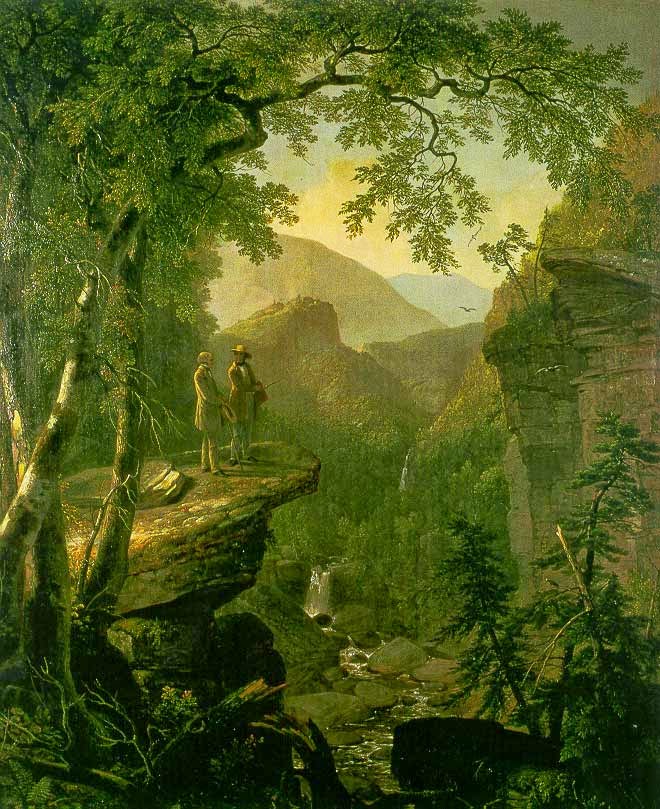
Kindred spirits
Kindred Spirits.
This is a painting done by Asher Brown Durand. It depicts the painter Thomas Cole and his friend William Bryant within the Catskill mountains. The painting isn't a the literal depiction of american landscape yet an idealisation of Cole's memory of the land and has possesses his ideas of American Nature. The painting was commissioned by a friend of Bryant who gave it to him as a eulogy of Cole who had died 1848. The scene is one that was depicted by both Cole and Bryant. Cole painted 'Kaaterskill falls' while Bryant wrote a poem called 'Caaterstill falls'. This painting takes inspiration from both pieces and ties them together by having both men gazing at the scenery. It has often been said that this painting captures the era of discovery that it depicts.
The pictures its self shows many aspects of the American landscape of the area of New York State. It shows the ferocity of the waterfalls leading into the calm river that shows the rocky shores. It shows the large mountain ranges of the region in the background which looks calm and contrasts with the manic trees in the foreground.
Monday, 2 February 2015
Hopi Tribe
The Hopi occupancy of Arizona
is one of the longest occupation of land of any Native tribe in the U.S.
dating back as far as 500 B.C. The Hopi located most of their villages on mesas
for defensive purposes with the area surrounding land for religious purposes.
With the majority of their land taken by the U.S. federal government through
various ways, to this day they only retain 9% of their original land (1.6
million acres) before the large amounts of immigration from the east cost.
The website the modern Hopi tribe have appears to push the
idea they were divinely chosen to rule those lands and have to soul right to
cultivate them. " Since time immemorial the Hopi people have lived
in Hopituskwa and have maintained our sacred covenant with Maasaw, the ancient
caretaker of the earth, to live as peaceful and humble farmers respectful of
the land and its resources."
There is vast information on the tribal government and its
history dating back to 1936 with the names of all their representatives in case
you would need to get in contact with any of them.
It even has a page for the "Hopi Code" this is the judicial section of the site showing you approved Hopi code of laws and Hopi civil procedure rules.
Other than that the rest of the sight just seems to keep you up to date with the tribal news and the different departments of the tribe. http://www.hopi-nsn.gov/
Catherine Sager Pringle Across The Plans in 1844
I have chosen to study the diary of Miss C. Pringle and her journey following her father, Mother and her six other siblings. Their travels begin from
In this time the Pringle family are emigrating through the
mountains where they stumble upon large amounts of Native Americans, through
this contact we can study the devastation that disease brought through
immigration towards the native people as some had never been exposed
to such illness there was no natural defense in the natives immune system
resulting in high amounts of casualties and in some cases tribes to be pushed
on the brink of extinction.
She also notes the behaviors of Native Americans towards the
Christian missionaries, claiming their minds were to savage to see the
difference between Catholicism and the protestants. Especially after the
missionaries blamed their lack of faith for the reason why the diseases were
effecting them so, the Natives become "hostile".
After a while of back and forth with the catholic church the
Natives become restless and began attacking travelers to protect their lands in
one case it resulted in the a local doctors house where Miss Pringle and two of
her brothers were staying to be almost over whelmed by a horde of Natives
resulting in many casualties on both sides. From this you could see the
paradoxical nature of how the practice of preaching religion was used during
these times.
I am back from Georgia and will see you tomorrow at 10.00.
As of midnight these people have posted (X)
I am rather taken aback by this. Three of you have not done the second post, never mind the third. What is the point you being here? Some of you came to see me or emailed me that you had turned over a new leaf.
Some of you even imagine you are going on the American Exchange, Not on this sort of performance you aren't.
As of midnight these people have posted (X)
|
|
1 West
|
2 Settler diary
|
3 Native America
|
|
Harry Chapman
|
X
|
X
|
X
|
|
Millie Wilshire Kelly
|
X
|
X
|
X
|
|
Alex Jackson
|
X
|
0
|
0
|
|
Luke King
|
X
|
0
|
0
|
|
PJ Higgs
|
X
|
0
|
0
|
|
Ruth McCarthy-Clegg
|
0
|
X
|
X
|
I am rather taken aback by this. Three of you have not done the second post, never mind the third. What is the point you being here? Some of you came to see me or emailed me that you had turned over a new leaf.
Some of you even imagine you are going on the American Exchange, Not on this sort of performance you aren't.
Sunday, 1 February 2015
Mississippi Band of Choctaw Indians
The Choctaw people have Three federally recognized tribes and the website I have chosen is for the Mississippi Band of Choctaw.
The website homepage has an introduction from Phyllis J. Anderson who is the tribal chief and she gives some basic information about the Mississippi Choctaw people, there are 10,000 members of the Mississippi Choctaw band and the tribe provides over 5,000 jobs in Mississippi to members and non-members.
The website features information about; amongst other things, tourism, government, business and culture, such as the Choctaw museum, cultural centre and other attractions on the Choctaw land like its water-park. There is also information on Choctaw history and activities such as dancing, cooking and arts & crafts. There is also information about cultural events like tribal council meetings.
The Mississippi band of Choctaw Indians is very successful and one of Mississippi's biggest employers, it went from a unemployment rate of 70% in 1997 to 3% in 2007 and has one of the largest casino resorts in the US. The website seems to reflect its continued success as there is information about new projects such as a new health centre and a cultural centre.
The website homepage has an introduction from Phyllis J. Anderson who is the tribal chief and she gives some basic information about the Mississippi Choctaw people, there are 10,000 members of the Mississippi Choctaw band and the tribe provides over 5,000 jobs in Mississippi to members and non-members.
The website features information about; amongst other things, tourism, government, business and culture, such as the Choctaw museum, cultural centre and other attractions on the Choctaw land like its water-park. There is also information on Choctaw history and activities such as dancing, cooking and arts & crafts. There is also information about cultural events like tribal council meetings.
The Mississippi band of Choctaw Indians is very successful and one of Mississippi's biggest employers, it went from a unemployment rate of 70% in 1997 to 3% in 2007 and has one of the largest casino resorts in the US. The website seems to reflect its continued success as there is information about new projects such as a new health centre and a cultural centre.
The Shoshone
The Shoshone
The Shoshone (also know and the Shoshoni) tribe occupied the western states of California, Idaho, Nevada, Wyoming and Utah. They lived in areas that were often difficult to survive in. They were attacked by both the elements and other Native Tribes. They became known for raiding other tribes and stealing their horses, and created a lot of enemies that way. In 1875 they were given protected land by President Grant yet in 1905 they faced their own "trail of tears" when they were moved to the reservation on the snake rivers of Idaho. althought it is stated that
The Shoshone are split into three different divisions. Western Shoshone, Northern Shoshone and Eastern Shoshone.
The Shoshone attacked many settlements in the north and more specifically Idaho where Chief Pocatello of the Northern Shoshone attacked many migrants from the north as he was worried about the impact they would have.
The website is intact rather outdates, but as of 2003 the Shoshone had not been a federally recognised tribe,yet as of 2015 they are.
The shoshone are often remembered because of Sacagawea and their involvement in
Lewis andClarks exploration of the west in the early 1800's. Although this is the case, I found it hard to find much more information on this tribe which is odd because it is one of a very few I can name and tell people about before I had researched them.
Excerpts of a letter from Sara Jane Pierce to her husband Hiram Dwight Pierce
http://www.glittering.com/letters/pierce2.html
This is a letter from Sara Jane Pierce to her husband Hiram Dwight Pierce. Hiram went to California in 1848 during the great gold rush to try and make his fortune. When Sara writes this letter he has been gone a year. She is very worried as she has not heard from him for a while and understandable fears the worse. She writes how everyone has him in their prayers and wishes him home safely. Even in this state of 'panic' she still writes to him about how the family are doing.
She writes that she is "Tired of repetition" she is clearly frustrated at the lack of reply from her husband and the fact that every letter that she sends is full of pain and sorrow because of the lack of knowledge of his whereabouts.
In the last paragraph she writes "permit you soon to return, is the earnest prayer of your ever faithful wife.". I feel that here she has put the line about her being faithful because during the Gold rush, many American men actually stayed in California and started a family. She is simply stating that she is waiting for him to return, and will always be. Maybe trying to persuade him to return to his faithful, loving wife and family
This is a letter from Sara Jane Pierce to her husband Hiram Dwight Pierce. Hiram went to California in 1848 during the great gold rush to try and make his fortune. When Sara writes this letter he has been gone a year. She is very worried as she has not heard from him for a while and understandable fears the worse. She writes how everyone has him in their prayers and wishes him home safely. Even in this state of 'panic' she still writes to him about how the family are doing.
She writes that she is "Tired of repetition" she is clearly frustrated at the lack of reply from her husband and the fact that every letter that she sends is full of pain and sorrow because of the lack of knowledge of his whereabouts.
In the last paragraph she writes "permit you soon to return, is the earnest prayer of your ever faithful wife.". I feel that here she has put the line about her being faithful because during the Gold rush, many American men actually stayed in California and started a family. She is simply stating that she is waiting for him to return, and will always be. Maybe trying to persuade him to return to his faithful, loving wife and family
Saturday, 31 January 2015
Wampanoag Tribe of Gay Head
The Wampanoag Tribe are situated in Aquinnah and throughout the island of Noepe.
The tribe website is simple, keeping images to the home page. An automatic slideshow of pictures shows the Aquinnah land, and is surrounded by menus, including events and news. Although the special events are up-to-date, the tribal news has not been updated since 2010.
Looking through the menu pages, the website is short and to the point. The History & Culture page gives a brief history of the tribe and the arrival of the European settlers, as well as some information on the legal status of the tribe.
The Tribal Council page gives a table of information about the council, and informs the visitor how the tribe's government works. The Departments page is much the same, containing just a table of information on each department.
The Special Events page features a calendar, which has no events listed, and the Tribal Housing Authority page, just as the Tribal Council page, has just a table of information and a brief description of the housing authority's purpose and aims. The Tribal Enterprises page features only two hyperlinks, one of which links to a page of the tribe website that gives no information other than an address and telephone, and the other of which links to an external site for the company, which is much more professional than the tribe website itself.
The simple and to-the-point website suggests that it is there for functionality, to provide an online resource for basic information and contact details of the tribe. The Aquinnah Wampanoag Enterprises website, meanwhile, was likely built by a professional web builder.
The tribe website is simple, keeping images to the home page. An automatic slideshow of pictures shows the Aquinnah land, and is surrounded by menus, including events and news. Although the special events are up-to-date, the tribal news has not been updated since 2010.
Looking through the menu pages, the website is short and to the point. The History & Culture page gives a brief history of the tribe and the arrival of the European settlers, as well as some information on the legal status of the tribe.
The Tribal Council page gives a table of information about the council, and informs the visitor how the tribe's government works. The Departments page is much the same, containing just a table of information on each department.
The Special Events page features a calendar, which has no events listed, and the Tribal Housing Authority page, just as the Tribal Council page, has just a table of information and a brief description of the housing authority's purpose and aims. The Tribal Enterprises page features only two hyperlinks, one of which links to a page of the tribe website that gives no information other than an address and telephone, and the other of which links to an external site for the company, which is much more professional than the tribe website itself.
The simple and to-the-point website suggests that it is there for functionality, to provide an online resource for basic information and contact details of the tribe. The Aquinnah Wampanoag Enterprises website, meanwhile, was likely built by a professional web builder.
Thursday, 29 January 2015
I will be back from Georgia this weekend and see you all for the small group on Monday. We will need to cover both the settler and the Native America posts, so the session will run from 10.00 until 12.00.
Tuesday, 27 January 2015
William Swain Letter: Written on the Trail to California
This account is from July 4Th 1849, and is
written by William Swain to his wife Sabrina, as he travels to California. When he writes he is eight miles from Fort Laramie, there is a celebration dinner in his camp,
which he has just left. The trip was successful and he writes of the “luck”
they had and the “uncommon good health” of the people he is travelling with, as
there has been little sickness and few accidents. He states that the water
is clearer and so is the air and that he is in better health than he was when
he left home but; in spite of this, he would “advise no man to come this way to
California”.
The letter is written in July and he tells his wife he will
probably not see her again until October he ends the letter with “Your
affectionate husband until death, William Swain”, he has already gone for many
months without seeing his family and it seems to be taking its toll, he also writes
of his homesickness but; unlike accounts by others, Swain seems to be enjoying
the trip overall. The letter seems uneventful compared to some other accounts but, is still interesting as it gives a more personal look into the effects of travel on the writer William Swain.
Monday, 26 January 2015
Letters and Journals of Narcissa Whitman
The letter discussed here is from a pioneer's wife, Narcissa Whitman, to her family back home.
On 30th Match 1837, Whitman wrote home to describe the birth of her baby daughter a fortnight earlier. Interestingly, she mentions that the she gave birth on her own birthday.
Whitman mentions that during the winter she was able to work, suggesting that it was not unheard of for women to work throughout pregnancy, as long as they were healthy. She then describes symptoms of an inflammatory rash and bleeding a week prior to the birth, and mentions a Mrs Pambrun, who had also been ill and had visited two weeks prior to Whitman falling ill - although Whitman doesn't specifically suggest it, it can be inferred from this that Mrs Pambrun may have infected Whitman with the illness. Mrs Pambrun is revealed to be a Native, when Whitman mentions that she was accustomed to dressing babies "in the native style."
Whitman then goes on to describe the baby's disposition for the first few nights. The baby cried the second night, and Whitman says it was because "she was hungry, and [they] did not think to feed her soon enough", a curious thing to hear today, as we are accustomed to knowing that babies should be fed almost immediately.
Whitman praises her husband's role throughout the labour, and mentions that he did the washing and cooking while she was unable to. She then describes how a group of Indians arrived, and many were curious to see the baby, having no doubt never before seen a white newborn. One of the Indians, Kee-low-ki-ke, tells Whitman that the baby is a "Cayuse te-mi (Catuse girl)." Interestingly, the pioneers here and the Indians appear to have a friendly relationship.
On 30th Match 1837, Whitman wrote home to describe the birth of her baby daughter a fortnight earlier. Interestingly, she mentions that the she gave birth on her own birthday.
Whitman mentions that during the winter she was able to work, suggesting that it was not unheard of for women to work throughout pregnancy, as long as they were healthy. She then describes symptoms of an inflammatory rash and bleeding a week prior to the birth, and mentions a Mrs Pambrun, who had also been ill and had visited two weeks prior to Whitman falling ill - although Whitman doesn't specifically suggest it, it can be inferred from this that Mrs Pambrun may have infected Whitman with the illness. Mrs Pambrun is revealed to be a Native, when Whitman mentions that she was accustomed to dressing babies "in the native style."
Whitman then goes on to describe the baby's disposition for the first few nights. The baby cried the second night, and Whitman says it was because "she was hungry, and [they] did not think to feed her soon enough", a curious thing to hear today, as we are accustomed to knowing that babies should be fed almost immediately.
Whitman praises her husband's role throughout the labour, and mentions that he did the washing and cooking while she was unable to. She then describes how a group of Indians arrived, and many were curious to see the baby, having no doubt never before seen a white newborn. One of the Indians, Kee-low-ki-ke, tells Whitman that the baby is a "Cayuse te-mi (Catuse girl)." Interestingly, the pioneers here and the Indians appear to have a friendly relationship.
Thursday, 22 January 2015
READ PLEASE
Hi All
I sent you all an email Tuesday (I asked you in class to check for it) but I cannot do Monda,s small group as I am in the US checking out a new exchange partner. Please post regardless.
I had hoped to do the small group instead on Thursday or Friday this week, but only two of you have replied so it can't be organised.
Assuming that does not work out and there are no more replies by Friday morning, there will be no small group on Settler diaries on Monday (the 26 Jan).
Two options then:
1) We make the session the week after on Feb 2nd longer and pick up the past week's stuff then - Native Americans and Settler diaries both.
2) We find another time to catch up later that week
I would prefer the first if it has to be.
Tuesday, 20 January 2015
Western America
PFI Western is an online store who sells a variety of items
what are as said on the website to be “All your western needs”.
From their wide
range of cowboy boots, cowboy hats, horse saddles and horse supplies, to their
selection of ‘western clothing’ and ‘western accessories’, PFI Western attempts
to build a clear understanding of what a
typical inhabitant of the west of America would wear, and key equipment what is
needed such as horse tack and horse saddle. This site very much appeals to the
nature of the cowboy culture in Western America, and in its self is trying to
promote the idea of who a Western American is.
Monday, 19 January 2015
American West
I have chosen the website 'AmericanWest.cc'. American West is fashion company based out in the west. The company hand crafts its goods which consist of mostly leather luxury items. They are perhaps best know for their hand crafted handbags which are praised for their longevity, so much so in fact that they offer a lifetime warranty with each item. The thing to look at here however isn't the warranty itself but the principle behind it. It is a principle that things should be built to last through all wear and tear, much like items were back in the days when western America thrived.
As much as this website pays homage to the west with its 'Westernised' models and its elaborate western theme amongst many other things, one can not help but feel an underlying sadness within American West website. This website is more of a social comment on how the west has had to adapt to survive. Whilst the website is of course centered around the West and the principles that surround it, its is striking how modernised American West actually is. From subtle things such as the drop down bars to the 'standard' high end fashion font and from not so subtle things such as the models. The models are not your typical western Americans; they're not tall, strong men but rather your typical modern male models. They're not small, fragile women in need of saving from cowboy John but rather a tall, independent looking female. The fact a female is even the feature of the website is a statement within itself.
America West is harsh reminder of how the western world has had to adapt and how, when it eventually does, lose its identity.
As much as this website pays homage to the west with its 'Westernised' models and its elaborate western theme amongst many other things, one can not help but feel an underlying sadness within American West website. This website is more of a social comment on how the west has had to adapt to survive. Whilst the website is of course centered around the West and the principles that surround it, its is striking how modernised American West actually is. From subtle things such as the drop down bars to the 'standard' high end fashion font and from not so subtle things such as the models. The models are not your typical western Americans; they're not tall, strong men but rather your typical modern male models. They're not small, fragile women in need of saving from cowboy John but rather a tall, independent looking female. The fact a female is even the feature of the website is a statement within itself.
America West is harsh reminder of how the western world has had to adapt and how, when it eventually does, lose its identity.
Sunday, 18 January 2015
The West and Fashion :p
For this weeks blog post I have chosen the subject of the fashion of the west and how it has become mainstream in modern life, through the website http://www.chickelms.com/.
Where in the times of the classic west clothing was worn only because it lasted the wear and tear of their harsh environment, it has now become more about fashion with designer boots and hats for all to buy. In the modern day the clothing worn by the pioneers of the west has become symbol for those who are hard working, rural and and proud to be of southern heritage. This shown in the website by the language it uses to describe the person you could become through the clothing, as it says you can go from "City-slicker" to "Wrangler, Cruel Girl, Rocky Mountain, Cinch, Petrol, Lawman, Stetson, Roper, Ruddock, Cowgirl Tuff, Scully, Ariat, Heart and Crowns". There does seem to be an overwhelming amount of sub-text throughout the site claiming you will become incredibly more masculine just by owning the traditional garments.
Saturday, 17 January 2015
Moore Longhorn Ranch
Moore Longhorn Ranch is a working ranch which doubles as a holiday destination in Texas.
As the home page loads up, the banner stands out at the top of the page.
As seen here, the banner advertises the ranch in a font typically associated with the Old West - it is the font one would usually expect to see above an Old West saloon. The text is accompanied by a background consisting of a wooden pattern as well as three images - two of people with horses, and another of cattle silhouetted against the sky. All these elements of the banner work to immediately present the website's visitor with the aesthetic of the Old West.
The design of the website itself brings a visual of the Old West, with the content made to look like a notice pinned on a wooden board, and the sunset on the horizon as the background image.
The text on the page presents a concise description of the ranch and the role of the visitor. Various phrases are bolded, such as "working ranch in the wide open prairie", "home-cooked meals" and "three day cattle drives". These phrases, along with headings using phrases such as "authentic Texas" and "real ranch experience" grab the attention of the visitor, ensuring that if the visitor is not going to read all the text, they see the important information - the emphasis on authenticity, informing the visitor that were they to stay at the ranch, they would get the idyllic Western experience.
The information pages are much the same, presenting the information in concise paragraphs, with key phrases highlighted. Each page is also illustrated with images, again advertising to the visitors of the experience they will have at the ranch, with images of animals and white people enjoying themselves as they conduct ranch activities.
As the home page loads up, the banner stands out at the top of the page.
As seen here, the banner advertises the ranch in a font typically associated with the Old West - it is the font one would usually expect to see above an Old West saloon. The text is accompanied by a background consisting of a wooden pattern as well as three images - two of people with horses, and another of cattle silhouetted against the sky. All these elements of the banner work to immediately present the website's visitor with the aesthetic of the Old West.
The design of the website itself brings a visual of the Old West, with the content made to look like a notice pinned on a wooden board, and the sunset on the horizon as the background image.
The text on the page presents a concise description of the ranch and the role of the visitor. Various phrases are bolded, such as "working ranch in the wide open prairie", "home-cooked meals" and "three day cattle drives". These phrases, along with headings using phrases such as "authentic Texas" and "real ranch experience" grab the attention of the visitor, ensuring that if the visitor is not going to read all the text, they see the important information - the emphasis on authenticity, informing the visitor that were they to stay at the ranch, they would get the idyllic Western experience.
The information pages are much the same, presenting the information in concise paragraphs, with key phrases highlighted. Each page is also illustrated with images, again advertising to the visitors of the experience they will have at the ranch, with images of animals and white people enjoying themselves as they conduct ranch activities.
Although there is no specific mention of the Old West, the website is clearly designed to cater to those with a lust for the Old West, with features such as font, page design, images and emphasis on phrases associated with the Old West clearly demonstrating that this website is designed to capitalize on the public romanticisation of the idyllic image of the Old West.
Friday, 16 January 2015
The West

I've decided to look at the website http://www.lonestarwesterndecor.com. I decided to look at this website because it offers a wide range of different items that are connected to the west (as the websites name suggests) It sells itself by saying that "Western decor is all about
spunk and spirit, bringing together the desert beauty of
the southwest with rugged cowboy charm and rustic good
looks." . So rather than focusing on the old west as
being a cut throat world where you went to gain your
fortune by working hard or even killing to get somewhere, they're
focusing on the west as a fashion statement in the modern world. They
sell a range of items from necklaces, wall art, bed covers and much more. I feel
that this website show that the west is still relevant today, but in a much
different way than before. In the 50's it was seen that the Cowboy way of life
was one that was desired, TV shows and film showed the west as being a place
where the good guy would win and everything would be lovely, Kids would dress
up as cowboy and indians and play. While today it seems that the 'fashion' of
the west is much more desirable. To be wearing a Native American style
necklace or a piece of clothing with a gun on it is the way that the western has
survived and is living today, Which to me is a shame.
Tuesday, 13 January 2015
Welcome
This group meets Mondays 10.00-11.30 in TAB 214.
First post
This group meets Mondays 10.00-11.30 in TAB 214.
First post
Post and analyse any example of any website
which markets the American West –
this can be a site selling historic or contemporary paintings or photographs,
clothing, hats, boots, jewellery, vacations, land and housing property or
anything else you can find to give us a snapshot of how the West is imagined
in America today.
|
Subscribe to:
Posts (Atom)